Blog

This is a collection of articles summarizing our thoughts on everything related to saddles and saddle-making.

(If you have time for just one article, read this and make sure this is not happening to you.)
A Severe Problem Few Cyclists Have
Over the past few years, we have been keeping track of a particular health issue experienced by roughly 1–2% of cyclists. It appears to be pretty severe for those affected, with the more troubling part being that for roughly half of these folks, they were not aware of the problem until it was too late. So read on, because you might very well be one of them.
A Bike Saddle Fitting
One of our users recently opted to have their Meld saddle fitted by a bike fitter. The installation was performed based on how the fitter normally installs other saddles, and our instructions were not followed. The installation was incorrect, and the user experienced discomfort while cycling as a result.
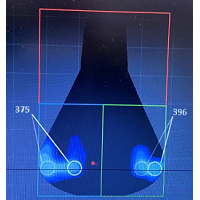
In the process of figuring out the root cause, we came across multiple aspects of pressure mapping which reinforced our thinking that the tool is lacking in certain key areas. We continue to believe that it isn’t a sufficiently good indicator of saddle comfort and cyclist sitbone + rami support.
The Elastic Shell Saddle
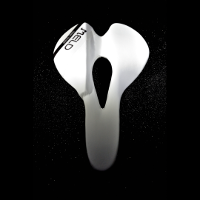
We are pleased to introduce our new general purpose bike saddles which are customized to each individual cyclist’s anatomy. These utilize elastic shells with emulated padding to provide superior comfort, edging out our ultra long distance cycling Alps shells and eliminating the need for padding in the cyclists’ bottom wear. The shells’ elasticity dramatically improves shock-absorption capability compared to carbon fiber ones. Consequently, our new saddles can be used for a multitude of applications including commuting, e-biking, stationary cycling, gravel riding, mountain biking, road cycling etc.
A Tale of Pelvic Asymmetry in Cycling
Most of our skeletal systems are symmetrical, and correspondingly, so are many cycling components such as bike frames, handlebars, cranks and saddles. But every now and then, one of us has an asymmetry that doesn’t fit in this world of symmetry. Resolving that conflict involves figuring out the root cause: what and where the asymmetry is, and then applying an appropriate fix if one can be found.
Asymmetry in Cycling
One of our most frequently asked questions is about asymmetry, so we thought we'll cover the key parts in this post.
Hip Rotation
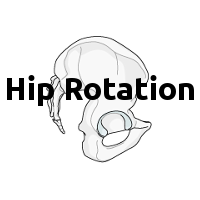
We’ve recently been talking to cyclists who aren’t sure why saddles with gradual tapering (also called V or pear-shaped saddles) are useful. We describe in this short article how it is related to the rotation of our hips while pedaling.
Chafing
Chafing is a result of friction wearing away the skin. Friction is always present, even when the skin is not yet worn and no discomfort is felt. With more time on the bike, there comes a tipping point when the skin breaks and we acutely and suddenly experience chafing. Since friction is always present, any action taken to reduce chafing needs to be employed before we experience discomfort.
A Quick Look @ Foam Imprints
We use custom foam blocks to capture each rider’s imprint. Our foam has high resolution and can capture details such as chamois location with respect to the sitbones. However, before we can make use of the benefits afforded by usage of such foam, the imprint must first be correctly captured.
Brief Study of a Well Used Meld Saddle
Not many people talk about well-used saddles and their repair. So we thought we’ll do that. Here’s a brief study of one of our saddles made in mid 2017 and its repair.
How to Check for Saddle Fit
After observing how some riders approach saddle installation and usage, we thought we’ll put together a short article outlining a few basic considerations when determining saddle fit. Whether you’re completely new to road cycling, a professional cyclist, or just someone who’s been cycling for a while, this article is for you.
Why Cutout Dimensions Matter
We’ve been asked a few times, “A cutout reduces the area of contact with the saddle, that means more pressure on the rest of the body. Isn’t that a bad thing?”
We gave some thought to that question and we believe that if the increased pressure is on load-bearing parts of the body and not on the perineum, then it’s fine. Put in a different way: if the cutout is wide and long enough to prevent any pressure from being placed on our perineum, then it is a good thing.
Fog of War - Uncertainties When Choosing The Right Saddle
‘Fog of war’ is a military term describing uncertainty in a situation due to the lack of information. In the context of saddles, we are often unaware of the necessary facts required to select the right saddle; when using a new one, it can be difficult to isolate the root causes and resolve issues that crop up. We discuss different aspects of this fog: the impact of sitbone width guesstimation, reference points used when providing and receiving saddle feedback, the conveyance of intended saddle usage from designer to the cyclist, and various contributing factors to specific problems.
Effective Surface Flexibility - The Saddle's 4th Dimension
We’ve been asked many questions about different aspects of a saddle and noted recurring misconceptions people have. In this short article we address two of them:
  • A saddle with less padding is less comfortable than one with more.
  • A different saddle with the same shape will work just as well.
The key in understanding why the two statements above may not always be true lies in how the effective saddle surface flexes while pedaling.

The Four Classes of Riders
We’ve interacted with a number of riders and observed how they went about adjusting their saddles’ fore/aft and tilt positions. We realized that they can be classified along two dimensions: knowledge of reference points, and inclination to tweak saddle position. This short article is written to disseminate information about how others adjust their saddles, and to shed some light on what to look out for.
Why Meld's Design Process Isn't Like Custom Bike Building's
Every now and then, someone comes up to us and tells us exactly what he wants as the shape of his custom saddle. His expectations of what the overall process should be is different from Meld’s automated way of generating saddle models based primarily on the anatomy. After encountering a few of these folks, we think that since they own custom-built bikes, perhaps they believe our process of making custom saddles should be similar. In this article, we explain why there are differences between the two.