Elastic Shell Saddle
by Meld Solutions
(Updated September 2022 - see below)

We are pleased to introduce our new general purpose bike saddles which are customized to each individual cyclist’s anatomy. These utilize elastic shells with emulated padding to provide superior comfort, edging out our ultra long distance cycling Alps shells and eliminating the need for padding in the cyclists’ bottom wear. The shells’ elasticity dramatically improves shock-absorption capability compared to carbon fiber ones. Consequently, our new saddles can be used for a multitude of applications including commuting, e-biking, stationary cycling, gravel riding, mountain biking, road cycling etc.
Emulated Padding
While our new saddle appears to have a minimalist single-piece design, it actually consists of a top and bottom layer.

The top layer is constructed using an elastic material and emulates traditional bike saddle padding. Together with our customization of saddle shape to the cyclist’s anatomy, it eliminates the need for padding in bottom wear. This makes our saddle suitable for applications such as commuting and at-home stationary cycling.

The emulated padding has been extensively tuned and is neither excessively soft nor thick. Based on our experience, soft and thick padding usually does not provide sufficient support and can result in chafing instead.
Elastic Support

Since we began designing and manufacturing customized saddles in 2016, we have worked with various appropriately-trained and regulated medical professionals such as physical therapists. These interactions continue to highlight the importance of having our saddles support the cyclists’ skeletal structure, i.e. the sitbones and rami.
To ensure that this requirement continues to be met, the bottom layer of our new saddles uses a material that is also elastic but is designed and constructed to be stiff. The elasticity dramatically improves our saddles’ shock-absorption capability, while the stiffness provides the necessary skeletal support.
Configuration Limitations
Our general purpose saddles are less configurable than our road and triathlon/TT saddles. They are currently only available in black, and do not include user-customizable graphics. They all include a cutout, but can no longer have a rear slope. Finally, they are only available with stainless steel metal rails.
Process Change
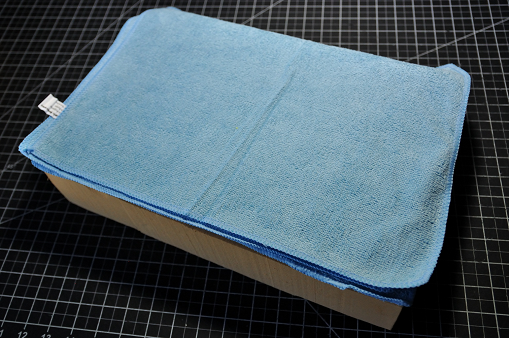
The process to acquire one of our general purpose saddles is very similar to that of our earlier saddles with one privacy-related difference.
One of the primary goals of sitting on the imprint foam with padded shorts on is to prevent private anatomy information from being captured in the imprint. As folks interested in our general purpose saddles may not have immediate access to padded bottom wear, we instead include microfiber cloth pieces with the imprint kit. These cloths serve as padding, and are to be stacked atop the imprint foam before sitting on it.
** Update Sep 2022 **
We thank everyone who has taken part in beta testing so far and given us feedback. We’ve made a few changes as a result.
Solving the Perineum Problem (Attempt #2197)
Every now and then we encounter a cyclist who mistake their perineum for their sitbones and use the former to support their weight. The troubling part is that we’ve encountered quite a few of these cyclists and found that they are seasoned riders and had been fitted by bike fitters. While we avoided making it comfortable when our carbon-based saddles are misused this way (the saddle will feel hard), there are folks who continue doing so in spite of the discomfort.
As a reminder: prolonged usage of the perineum to support weight has a significant chance of resulting in long-term health problems. Typically, changes occur in the perineum over a long period of time and eventually result in the need for surgery. While this can mitigate issues in the near term, there are generally lasting effects that impact all activities involving “the area down there” and lower quality of life. Due to the sensitive nature of the problems “down there”, cyclists generally do not talk about it with people they know in person.
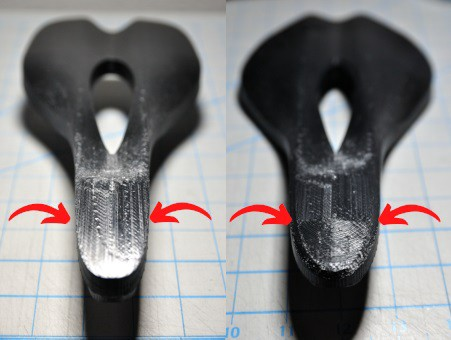
Since we have more control over the design of our beta saddle, we thought we would try harder at discouraging cyclists from sitting on the nose by tweaking the design. Specifically, we left the edges of regions where the cyclist aren’t supposed to sit on unrounded. An example would be the edges of the saddle nose as shown below:

This worked really well. We encountered a number of beta testers who experienced non-health-related issues due to the unrounded edges, and talked to us about it. We subsequently verified that they were indeed using their perineum and not sitbones to support their weight. Overall, we are really glad that we figured this out before they suffered from long-term problems.
Having unrounded edges does have a drawback: these edges are perceived to be sharp and some cyclists wondered if they should sit on the saddle. We understood the concern and after some thought we altered the design somewhat: edges around the top surface were beveled and now appear more acceptable.
Surface Smoothness
We also continued working with the elastic material to improve our understanding and expand on our capabilities. An aspect of the saddle we are interested in is the smoothness of its surface.
In general, it isn’t a good idea to have the saddle surface be so sticky as to make it noticeable when the cyclist moves around: this takes away from the riding experience. In addition, a sticky surface means that rather than our shorts and chamois moving with our body as we pedal, they stick to the saddle and move against our body instead. This increases chafing of our skin particularly around our sitbones and rami area, hence increasing the chances of saddle sores appearing.
We investigated multiple ways of processing our saddle, the result is a smoother and noticeably shinier surface:
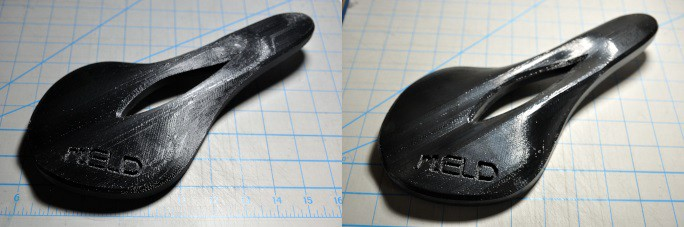
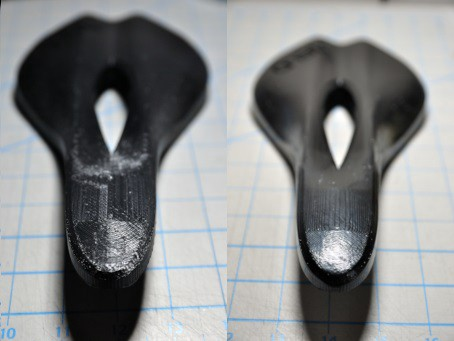
We were debating whether this improved surface feels significantly smoother while cycling. The concensus is that when we sit and put our weight on it, it feels the same as our carbon-based synthetic leather saddles. However, when our weight is not fully on the saddle, for instance when we are getting onto it or when we push hard on the pedals, it feels easier to slide around on. We settled on “marginally smoother”.
Sagging
A couple of beta-testers were also concerned that the middle of the saddle sags downwards when sitting on it. This is to be expected as the shell is elastic and not stiff like carbon fiber. In addition, the shell can technically stretch all the way down to the rails and not tear, although this should not happen in reality. In any case, the saddle should regain its original shape when we get up from it.

Current Status
We have decided to open purchase of our elastic saddles to cyclists weighing less than 180lbs, with certain exceptions. If you are interested in purchasing one, send us an email at info@meld3d.com before placing an order. Beta testing will continue for the weight range 180lbs to 240lbs. If you are interested in helping us test and haven’t yet emailed us, let us know and we will add you to our list. Again, the cost of a beta saddle is US$175.
Found this article useful? Check out other cycling-related stuff at meld3d.com/blog