A Bike Saddle Fitting
One of our users recently opted to have their Meld saddle fitted by a bike fitter. The installation was performed based on how the fitter normally installs other saddles, and our instructions were not followed. The installation was incorrect, and the user experienced discomfort while cycling as a result.
In the process of figuring out the root cause, we came across multiple aspects of pressure mapping which reinforced our thinking that the tool is lacking in certain key areas. We continue to believe that it isn’t a sufficiently good indicator of saddle comfort and cyclist sitbone + rami support.
Pressure Mapping Did Not Indicate Discomfort

Our user initially reported discomfort around their sitbones during pedaling. While looking into this, we obtained the corresponding pressure map (screenshot shown in Picture A) from the bike fitter. We determined that the issue was due to the saddle being tilted nose up (which it wasn’t supposed to be), resulting in the cyclist sitting further back than designed and in an unintended ‘indent’.
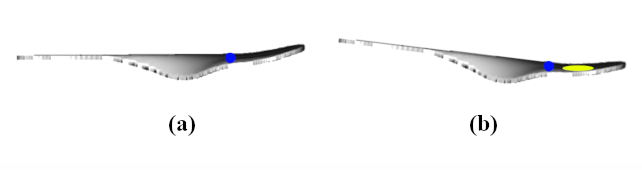
In Picture B, the blue spot indicates the correct sitbone location, and the yellow oval (b) shows the location of the ‘indent’ created when the nose is tilted up. In (b), the cyclist ends up sitting in the ‘indent’, while the blue spot, being higher, impinges on the front of the sitbone while pedaling causing the discomfort. This effect was not captured in the pressure mapping.
If we cannot tell whether the cyclist will experience discomfort based on their corresponding pressure map, we shouldn't be relying on the map to find a suitable saddle and setup for them.
Lack of Information To Determine Whether Sitbones + Rami Are Properly Supported
While interacting with the bike fitter, we also verified our previous observations on pressure maps. We do not believe these capture sufficient information to accurately determine the cyclist’s sitbone and rami locations. In addition, the fitter acknowledged that the other tools available to them do not do a good job of figuring these out either. We agree with them on this.
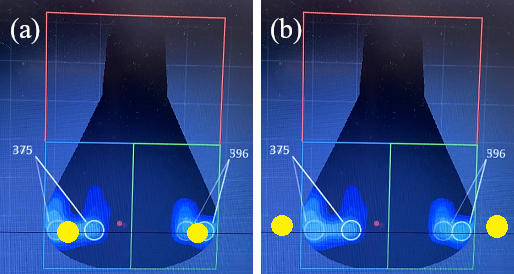
Without knowing the sitbone locations on the saddle, we cannot reliably determine whether they are properly supported. Picture C shows two different scenarios where the sitbones are supported by the saddle (a), and not (b). In both cases, the pressure map does not indicate whether that pressure is on the sitbones (a) or perineum (b).
We can extend this scenario further: if the cyclist is in a more aggressive posture, with hips rotated, we can’t tell from the pressure map if their rami is actually supporting their weight.
Note that excessive pressure on the perineum for extended periods of time has a significant chance of causing long-term health problems.
Summary So Far
a) We found that pressure maps may not correctly reflect discomfort experienced on a saddle. Hence, we do not think pressure maps can reliably determine which saddles or setups are more comfortable.
b) We believe that pressure maps cannot reliably indicate whether the cyclist’s sitbones + rami are properly supported. With excessive perineum pressure, there is a significant chance that the cyclist will develop long-term health problems.
“So now you’re going to tell us Meld saddles can solve all these problems?”
Meld saddles can solve all these problems:
a) We can accurately determine the cyclist’s (effective) sitbone width, to within 2 mm (not cm) of MRI scans, using the anatomy imprints we capture.
b) With correct installation and the cyclist sitting upright on the widest part of the saddle, their sitbones will be properly supported. This is by design. When getting into an aggressive posture with rotated hips, their rami will be supported. This is also by design.
c) Our saddle models are constructed based on our users’ imprints, which are considerably more accurate than pressure maps. Even then, we realized very early that this alone was not sufficient for the level of comfort we’re aiming for, and had to continue working on the design until we were satisfied.
It’s Easy To Install A Meld Saddle Correctly
The majority of our users successfully installed their saddles themselves without having to get them fitted by third parties. It’s pretty straightforward: just follow the instructions we provide.
Found this article useful? Check out other cycling-related stuff at meld3d.com/blog